

If you are searching for a convenient base for a weekend escape, consider our rental house in Kamieńczyk on the Bug River. It offers not only comfortable space for relaxation but also an excellent starting point for short excursions, active weekends, and longer holidays.
Discover the peace and natural beauty of Nadbużański Landscape Park, one of Poland’s most picturesque regions. It is an excellent destination for anyone wishing to rest in quiet surroundings while remaining close to nature, regional traditions, and historic landmarks. Located less than 100 kilometres from Warsaw, the area attracts visitors with its varied landscapes, rich wildlife, and numerous cultural attractions.
1. Where Is Nadbużański Landscape Park Located?
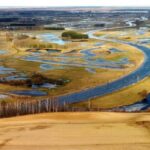
Nadbużański Landscape Park lies in the central-eastern part of the Mazowieckie Voivodeship. It covers the left bank of the Lower Bug Valley, extending from the mouth of the Toczna River in Drażniew to the place where the Liwiec flows into the Bug near Kamieńczyk. The protected area also includes a section of the lower Narew River.

The park is situated where three historic regions meet: Mazovia, Kurpie, and Podlasie. This location has shaped the distinctive cultural identity of the area, which can be seen in local customs, traditional architecture, and regional heritage.
The park covers 74,136.50 hectares, while its total area together with the buffer zone amounts to 113,671.70 hectares. Its landscape includes winding rivers, oxbow lakes, peatlands, riparian forests, meadows, grazing land, and extensive woodland complexes such as Puszcza Biała, the Łochów Forests, the Ceranów Forests, and the Miedzyń Forests.
Established in 1993, the park was created to preserve the exceptional landscape of the Bug Valley, its diverse plant and animal life, and the historical and cultural heritage of the region. Nadbużański Landscape Park is a place where nature and history complement each other, while its relatively short distance from Warsaw makes it a convenient destination for both weekend breaks and longer stays.
2. The Flora and Fauna of Nadbużański Landscape Park
Because of its remarkable environmental value, parts of Nadbużański Landscape Park have been included in the Natura 2000 network. Special Protection Areas for birds have also been designated within the park and its buffer zone, including the Lower Bug Valley and the Liwiec Valley.
Protection covers the naturally meandering Bug River, oxbow lakes, forest complexes, rare plant and animal species, xerothermic grasslands, riparian forests, traditional rural buildings, and the varied landscape characteristic of the region.
Approximately 36% of the park is covered by remnants of historic forests, with pine woodland being particularly common. Rare plants found in the area include mezereon, European columbine, martagon lily, large yellow foxglove, twinflower, goat’s beard, European globeflower, floating fern, English sundew, and flattened clubmoss. Visitors may also come across wild orchids and unusual grass species.
The park is one of the most important wildlife habitats in the Polish lowlands. More than 191 bird species have been recorded here, including wetland species such as the Eurasian curlew, common snipe, lesser spotted eagle, and several species of tern.
The forests provide shelter for moose, red deer, wild boar, and roe deer, while beavers and otters inhabit the rivers. Amphibians include the European tree frog and great crested newt. Reptiles such as the European pond turtle and smooth snake can also be found in the region.
The Bug and its tributaries support around 48 fish species, including barbel, common nase, and vimba bream.
3. Exploring Nadbużański Landscape Park by Bicycle
Nadbużański Landscape Park offers excellent conditions for cycling. Its routes lead through river valleys, dense forests, open meadows, and traditional villages. This variety means that both families with children and experienced cyclists can find a suitable trail.
One of the region’s most important routes is the Bug River Cycling Trail. Marked in blue, it is approximately 420 kilometres long and follows the scenic Bug Valley from Wyszków to Hrubieszów. The trail crosses areas of exceptional environmental and cultural value.
Most sections remain away from heavily trafficked roads, which makes cycling quieter and more comfortable. However, because route markings may be incomplete in some places, using GPS navigation is recommended.
The western part of the park, closest to Warsaw, also offers several shorter routes suitable for one-day trips. Their starting and finishing points can usually be reached conveniently by car or train.
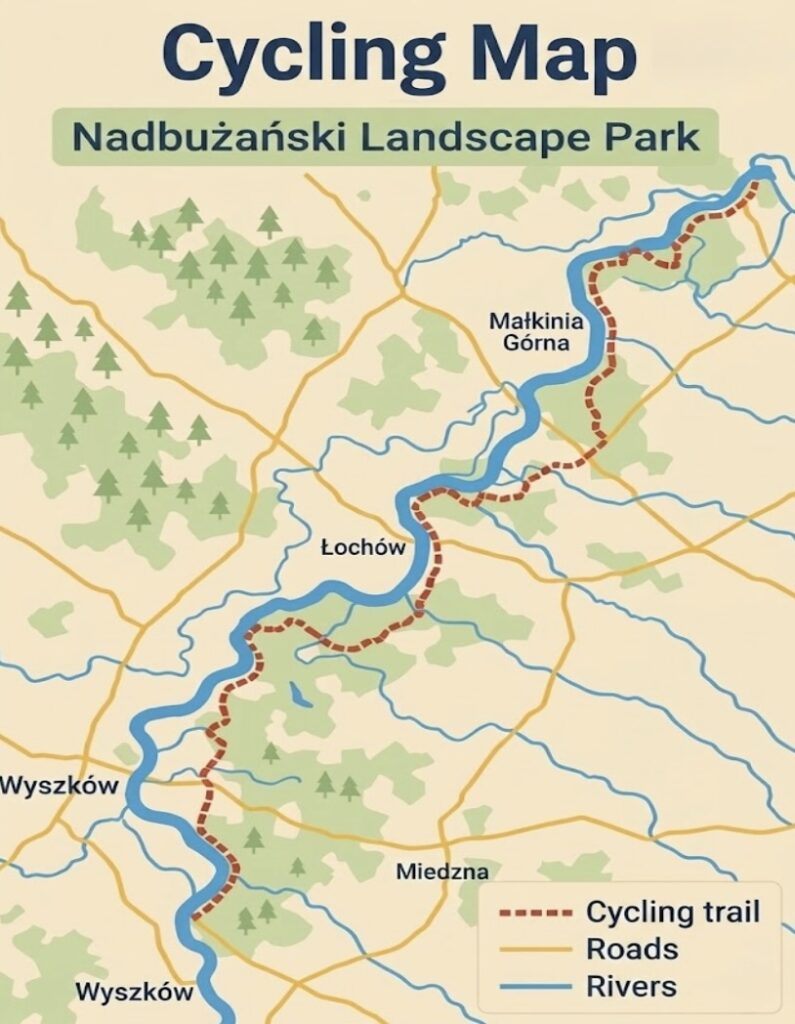
Route 1: Wyszków – Brańszczyk – Brok – Małkinia Górna
- Length: approximately 50 km
- Places along the route: Wyszków → Brańszczyk → Udrzyn → Brok → Małkinia Górna
- The route follows the northern bank of the Bug through picturesque forest and rural landscapes. In Brok, it is worth stopping near the historic church and resting by the river. Małkinia Górna has a railway station with convenient connections to Warsaw.
Route 2: Kamieńczyk – Urle – Jerzyska – Łochów
- Length: approximately 40 km
- Places along the route: Kamieńczyk → Urle → Jerzyska → Łochów
- This route passes through forests and follows sections of the Liwiec River. Urle offers pleasant places to rest near the water, while the Jegiel Nature Reserve near Jerzyska is worth visiting. Łochów provides a convenient railway connection back to Warsaw.
Route 3: Huta Gruszczyno – Treblinka
- Length: approximately 31 km
- Places along the route: Huta Gruszczyno → Stoczek → Miedzna → Kosów Lacki → Treblinka
- The trail runs through traditional Mazovian villages and finishes near the museum in Treblinka. It is a suitable option for visitors interested in combining physical activity with the history and culture of the region.
4. Kayaking and Wild Beaches — An Active Weekend on the Bug
The western section of Nadbużański Landscape Park is an excellent destination for active recreation surrounded by nature. The winding Bug River, bordered by riparian forests and woodland, offers both gentle kayaking routes and access to secluded sandy beaches away from crowded tourist areas.
Recommended kayaking routes include:
- Kamieńczyk – Brańszczyk, approximately 15 km
This calm section is suitable for beginners. Along the way, kayakers can admire natural riverbanks, riparian forests, and numerous birds. Both Kamieńczyk and Brańszczyk offer convenient places to begin and finish the trip, as well as kayak rental services. - Brok – Małkinia Górna, approximately 20 km
This medium-difficulty route follows a more open section of the Bug, with many bends and sandy shallows. Several places along the riverbank are suitable for short breaks. - Wyszków – Kamieńczyk, approximately 12 km
A short and relaxing route that works well for a one-day outing. The river is generally calm along this section, and wild beaches and informal rest areas can be found beside the water.
When planning a kayaking weekend, it is advisable to reserve equipment in advance, particularly during the summer season. Kayaks can be hired in places such as Kamieńczyk, Wyszków, or Brok.
Life jackets and waterproof bags are essential, as water levels and conditions on the Bug can change. Accommodation in the house in Kamieńczyk makes it possible to combine a day on the river with comfortable relaxation afterwards.
Among the most interesting beaches are:
- the beach in Kamieńczyk, a natural sandy area near the mouth of the Liwiec into the Bug;
- small wild beaches surrounded by pine woodland near the meeting point of the two rivers;
- beaches in Brok, where quieter riverside areas can be found beyond the main tourist infrastructure.
5. A Journey Through History — Liw Castle and Other Regional Landmarks
Exploring the historical attractions around Liw Castle and Nadbużański Landscape Park is an excellent way to combine nature, regional history, and active sightseeing. The area works well for either a one-day trip or a longer weekend stay.
Picturesquely situated beside the Liwiec River, Liw Castle is one of the most interesting monuments in eastern Mazovia. It was built at the beginning of the 15th century on the initiative of Duke Janusz I the Elder and originally protected the borders of the Duchy of Mazovia.

Today, the castle houses the Armoury Museum, where visitors can see an impressive collection of weapons and historical objects. The green surroundings and views of the river make the area suitable for a walk and a quiet moment of rest.
| Kayaking route | River | Length | Estimated duration | Difficulty | Distance from Warsaw |
|---|---|---|---|---|---|
| Liw – Wyszków | Bug | approx. 22 km | 5–6 hours | Easy | 85 km |
| Kamieńczyk – Brańszczyk | Bug | approx. 15 km | 4–5 hours | Easy | 70 km |
| Wyszków – Brok | Bug | approx. 30 km | 7–8 hours | Medium | 90 km |
| Sadowne – Turna Mała | Bug | approx. 18 km | approx. 5 hours | Easy | 105 km |
| Łochów – Kamieńczyk | Liwiec and Bug | approx. 20 km | 5–6 hours | Easy | 70 km |
Selected kayaking routes located within a convenient driving distance from Warsaw.
Other notable historical attractions in and around Nadbużański Landscape Park include:
- St Leonard’s Church in Liw — an 18th-century wooden church representing traditional local sacred architecture. Both its construction and richly decorated Baroque interior are worth seeing.
- The Minor Basilica in Węgrów — an impressive Baroque church containing the famous mirror connected with the legend of Twardowski. The building forms an important part of the region’s cultural and religious heritage.
- The Reformati Monastery and Kalwaria Podlaska in Serpelice — a monastery complex set in a picturesque location above the Bug. Its symbolic Stations of the Cross combine spiritual meaning with architectural and scenic value.
- Wooden churches and roadside chapels — villages such as Grębków, Korytnica, and Stoczek contain numerous wooden religious buildings characteristic of the cultural landscape of this part of Poland.
Nadbużański Landscape Park remains quiet and relatively free from mass tourism. Historic buildings and natural scenery form a distinctive setting for sightseeing and relaxation.
6. Mushroom Picking and Discovering Wild Plants
Autumn is an excellent time to visit Nadbużański Landscape Park for mushroom picking and learning about wild plants. This form of recreation may appeal to families, nature enthusiasts, and people interested in traditional herbalism.
The Bug Valley contains many deciduous and mixed forests. In autumn, mushroom pickers can find porcini mushrooms, slippery jacks, bay boletes, birch boletes, and chanterelles. Moist conditions and morning fog support their growth.
Numerous walking paths make it easier to explore the forest, while advice from local mushroom pickers can help visitors identify areas where mushrooms commonly grow.

Nadbużański Landscape Park is also a good place to learn about edible and medicinal wild plants.
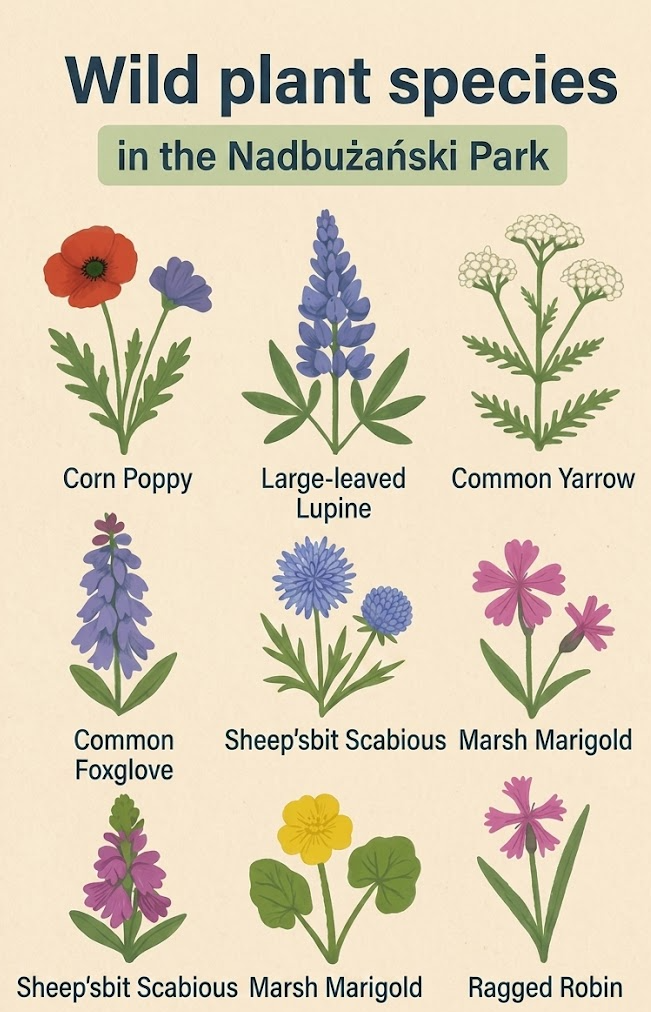
Nettle, yarrow, wild rose, and mullein can be found in meadows and along forest edges. Workshops led by experienced herbalists are sometimes organised in the region. Participants learn how to identify and collect plants safely and how to use them when preparing infusions or natural cosmetics.
An autumn stay can also include a visit to a local agritourism farm, where visitors may try regional preserves, dried mushrooms, and herbs collected from nearby meadows. This type of experience fits naturally with the idea of resting in harmony with the surrounding environment.
7. Ideas for Active Recreation on the Bug
There are many ways to remain active in the western part of Nadbużański Landscape Park, particularly near Liw, Węgrów, Miedzna, and Kamieńczyk. Whether you choose a short trip or a longer stay, it is easy to create a varied programme.
A kayaking trip on the Liwiec or Bug is one of the most popular activities. The Liwiec is particularly suitable for beginners and families because of its generally gentle current. A trip can begin in Liw or Starowola and finish near the mouth of the river in Kamieńczyk.
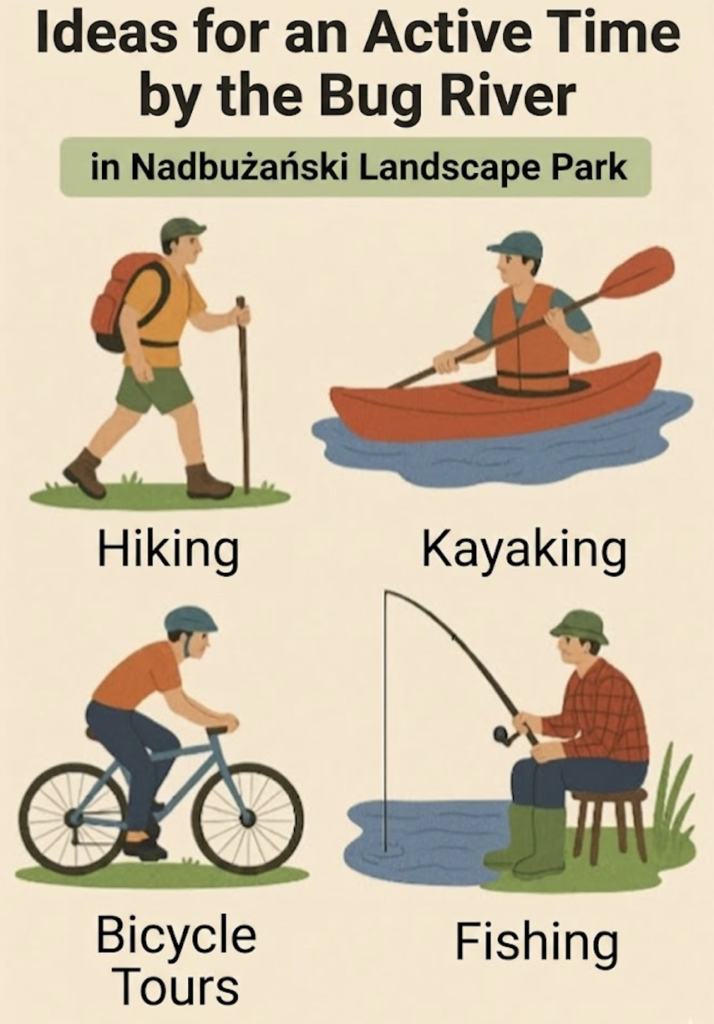
Cycling is another good way to discover the region. Scenic routes around Węgrów and Liw pass historic buildings, viewpoints, villages, and rural farms.
A walk beside the Bug offers opportunities for birdwatching, landscape photography, and quiet relaxation. During autumn, it is worth taking a basket into the forest, as the area is rich in mushrooms and wild plants.
Visitors interested in history can combine walking with sightseeing by visiting Liw Castle, the market square in Węgrów, or wooden churches in nearby villages. Physical activity can therefore be easily combined with learning about local traditions and heritage.
8. The Most Interesting Places for a Family Weekend
A family weekend in Nadbużański Landscape Park can include many educational and active attractions.
Places worth adding to the itinerary include:
- Liw Castle and the nearby stronghold beside the Liwiec — the historic fortress and weapons museum can interest both children and adults. Nearby archaeological remains and riverside paths provide opportunities for a family walk and an outdoor history lesson.
- Węgrów, its historic centre, basilica, and Twardowski’s mirror — the Baroque church and attractive market square appeal to adult visitors, while younger guests may enjoy the legend connected with the mysterious mirror.
- The Stawy w Kaliskach Nature Reserve — a pleasant location for a family walk and birdwatching. Wooden footbridges and viewing platforms help visitors explore the area.
- Kalwaria Podlaska in Serpelice — the route between the Stations of the Cross leads to a hill overlooking the Bug Valley. It is suitable for both reflection and an active walk in natural surroundings.
- Kayaking on the Liwiec — the river’s gentle current makes selected sections suitable for family trips. The route offers attractive scenery and opportunities to rest beside the water.
9. A Rental House Near Nadbużański Landscape Park
When planning either a short visit or a longer holiday near Nadbużański Landscape Park, it is advisable to reserve accommodation in advance. The selected property should provide convenient access to local attractions and a standard suited to the needs of the guests.
The rental house in Kamieńczyk is worth considering for visitors who value comfort and privacy. Its interior has been designed to a high standard, while the available amenities make it suitable for relaxation throughout the year.
Guests can use a sauna, swimming pool, hot tub, elliptical trainer, games, and books. The spacious garden includes a children’s play area, sun loungers, a barbecue, and outdoor furniture.
The building is air-conditioned and equipped with security shutters and an alarm system. A private parking space is also available on the property.
Its location in Kamieńczyk makes the house a convenient starting point for cycling trips, kayaking, walks along the river, and excursions to the most interesting attractions of Nadbużański Landscape Park.
10. Nadbużański Landscape Park — An Escape from the City
Located less than 100 kilometres from Warsaw, Nadbużański Landscape Park extends along the scenic Bug Valley. It is one of Poland’s largest landscape parks and provides visitors with space, quiet surroundings, and close contact with wildlife.
The Bug Valley, surrounded by forests, meadows, and riverside hills, changes throughout the year. Rare birds such as black storks and corncrakes can be observed in the area, while roe deer, hares, and even moose may appear in the surrounding countryside.
The park is particularly attractive to people who enjoy outdoor activity. The quieter sections of the Bug and Liwiec are suitable for kayaking, while walkers and cyclists can use trails running through forests, villages, and riverside meadows.
Limited road traffic and the natural character of the area make the region welcoming to families with children.
Local agritourism farms offer opportunities to try regional products such as cheese, preserves, honey, and homemade bread. Visiting them provides a chance to slow down and become familiar with local traditions.
The relatively low level of commercial development also supports peaceful family tourism. Nature trails, small animal parks, herbal workshops, playgrounds, cycling routes, and walking paths create varied opportunities for spending time together.